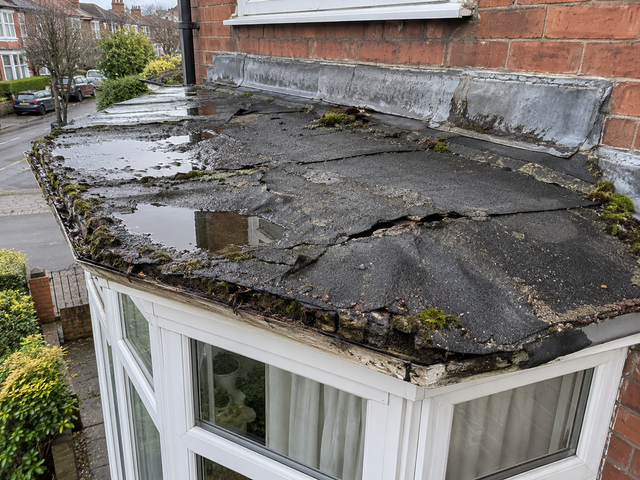
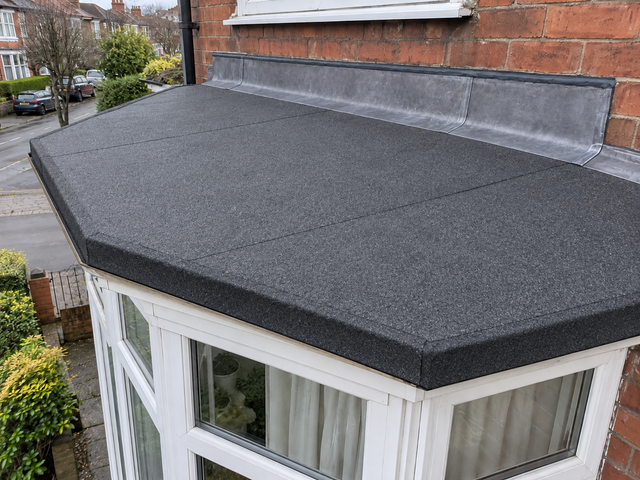
The covering has worn out
Many flat bay roofs are covered in felt that is decades old. It cracks, blisters and holds standing water until it lets rain through. Lead bay roofs can split if the sheets are too large, and tiled bays suffer from slipped or broken tiles like any other roof.
The flashing has failed
Where the bay roof meets the house wall it is sealed with lead flashing. If the lead lifts or the mortar holding it falls out, rain runs down the wall behind it. This often shows as damp at the back of the bay, near the main wall.
The deck has rotted
Once water gets past the covering it soaks the boards underneath. A bay roof that feels soft, sags or holds deep puddles usually has a wet or rotten deck that needs replacing along with the covering.
Is it the roof or the window?
Damp at the top of the bay or on its ceiling points to the roof. Damp at the sides of the frames or on the sill is more likely to be failed window seals or pointing. Condensation on the glass is a ventilation issue, not a leak.
How a bay roof is repaired
- Small splits and failed flashing can be repaired on an otherwise sound roof
- A worn-out covering is stripped back to the deck
- Rotten boards are replaced and insulation checked
- A new covering in felt, EPDM rubber, fibreglass or lead is laid
- New lead flashing is dressed into the wall
Do not leave it
Water from a leaking bay roof runs into the window head and the wall below, so a small roof repair can turn into plastering and joinery work if it is left.